
I headed to Hokkaido, Japan, in February 2026 with two visual themes already shaping the journey in my mind: Vibrant Hokkaido and Traditional Japan. (post upcomingon Traditional Japan)
I was drawn to the contrast between Hokkaido’s vivid winter character — cranes, foxes, snowfields, isolated color, landscapes — and the quieter monochromatic side of Japan that emerges through mist, overcast skies, bare forests, and restrained tonal palettes.
What I did not anticipate was discovering an entirely different visual phenomenon altogether: what I now think of as layered winter landscapes.
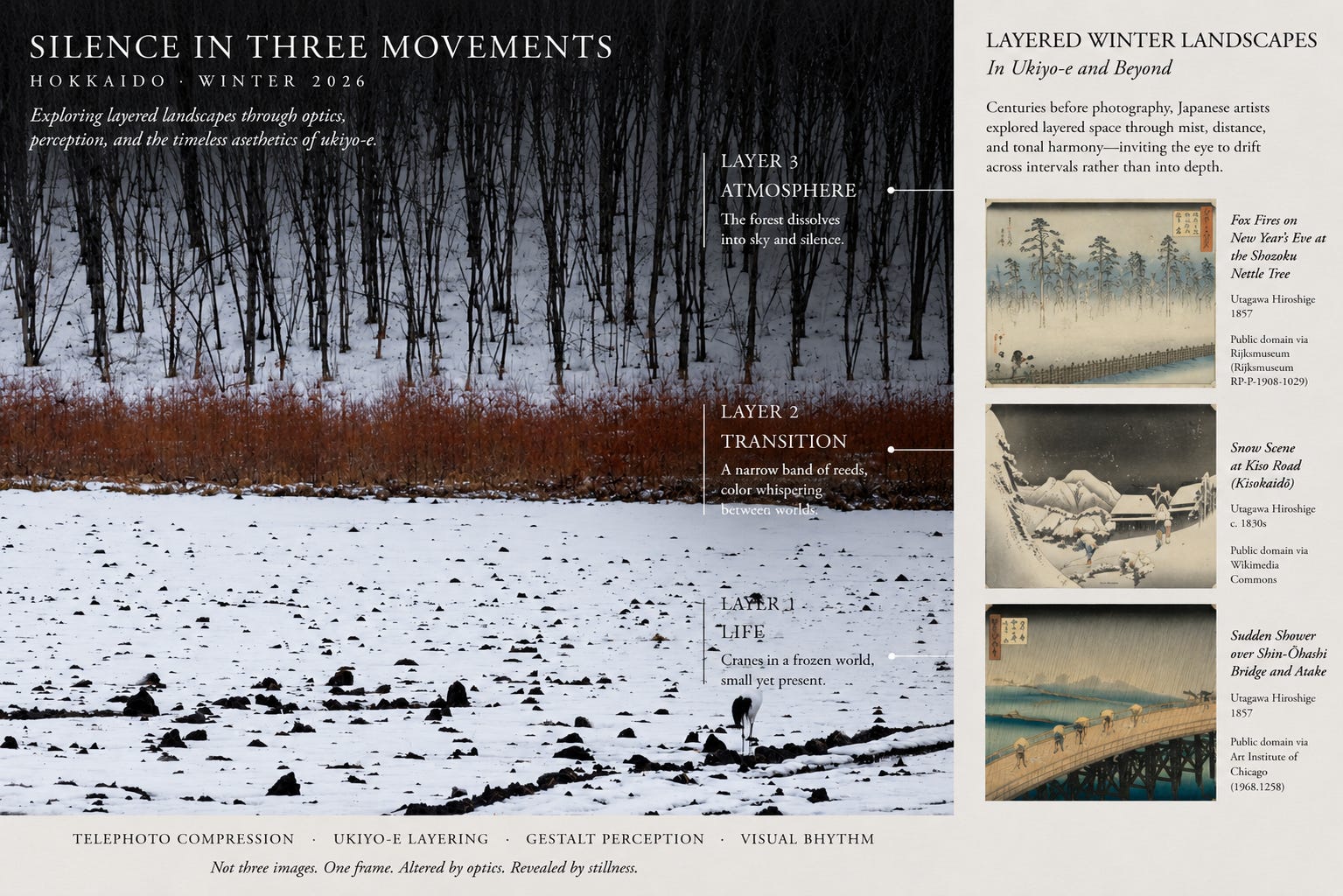
Somewhere during the trip, while photographing frozen wetlands and distant forests through a telephoto lens, I began noticing that the landscape no longer behaved as a single continuous scene. Instead, it appeared to separate itself into distinct visual planes — snowfields, reed belts, dense trunks, atmospheric canopy — each carrying its own tonal identity.
The effect was subtle in reality but became remarkably pronounced through the viewfinder.
That discovery was unexpected.
I had travelled searching for color and monochrome as emotional themes, but Hokkaido quietly revealed a third visual language to me — one built not around color, but around compression, atmosphere, tonal separation, and layered perception.
The more time I spent with these scenes, the more they began feeling less like traditional wildlife photographs and more like studies in visual structure.
The snowfields simplified the foreground into negative space.
The narrow reed belts became transitional bands of muted color.
The forests compressed into repeating vertical rhythm.
The distant canopy dissolved softly into atmosphere.
What fascinated me most was that this separation only became obvious through the camera itself.
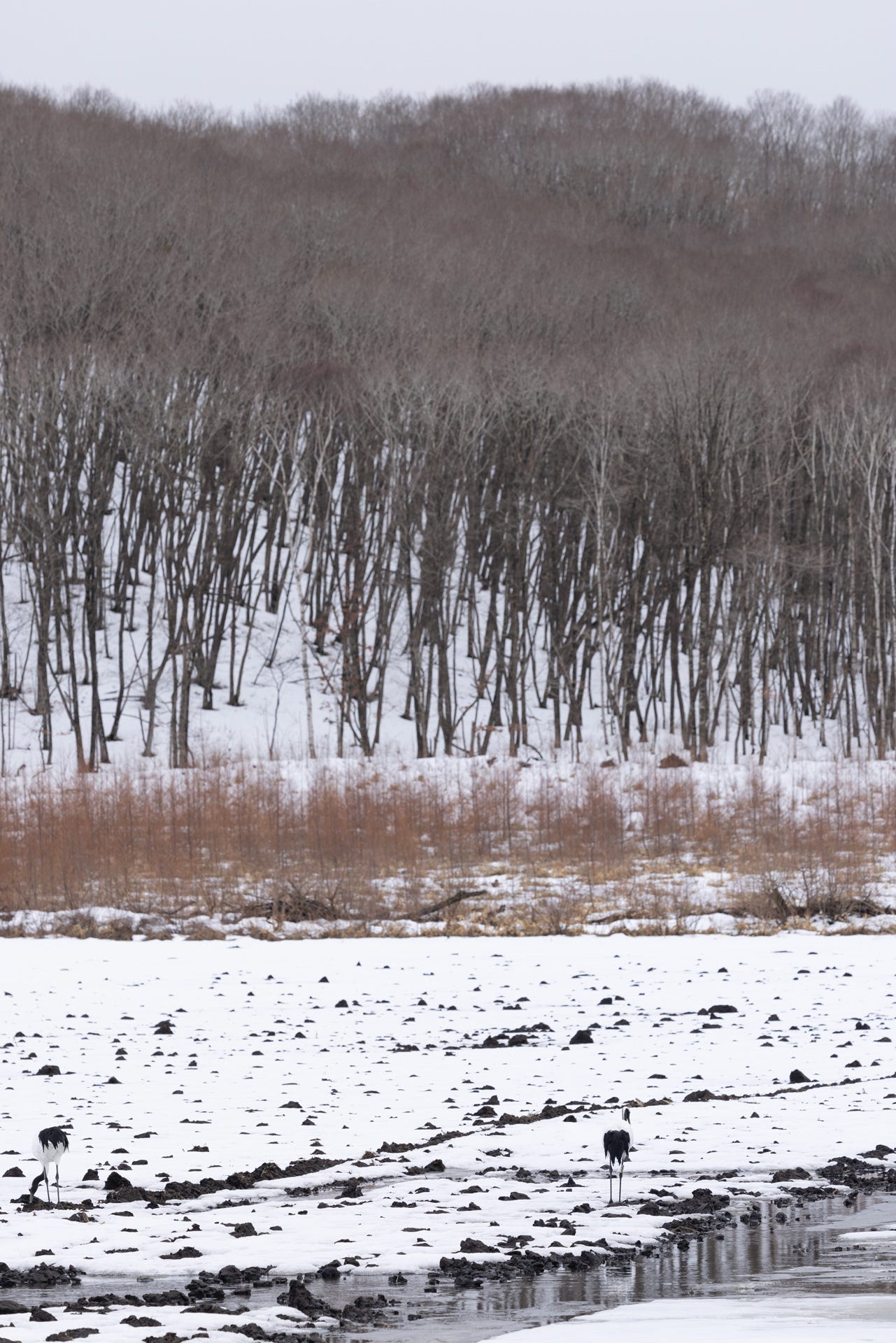
Standing in the landscape, I did not experience the scene as strongly layered in this way. But once framed through a long lens, the environment transformed. The world flattened, distance compressed, and the landscape started behaving almost like a composed arrangement rather than a naturally receding space.
It was as though the camera was not only recording the landscape — but reorganizing it.
Understanding the Layers
The more I photographed these scenes, the more I realized that several visual ideas were quietly working together inside the frame.
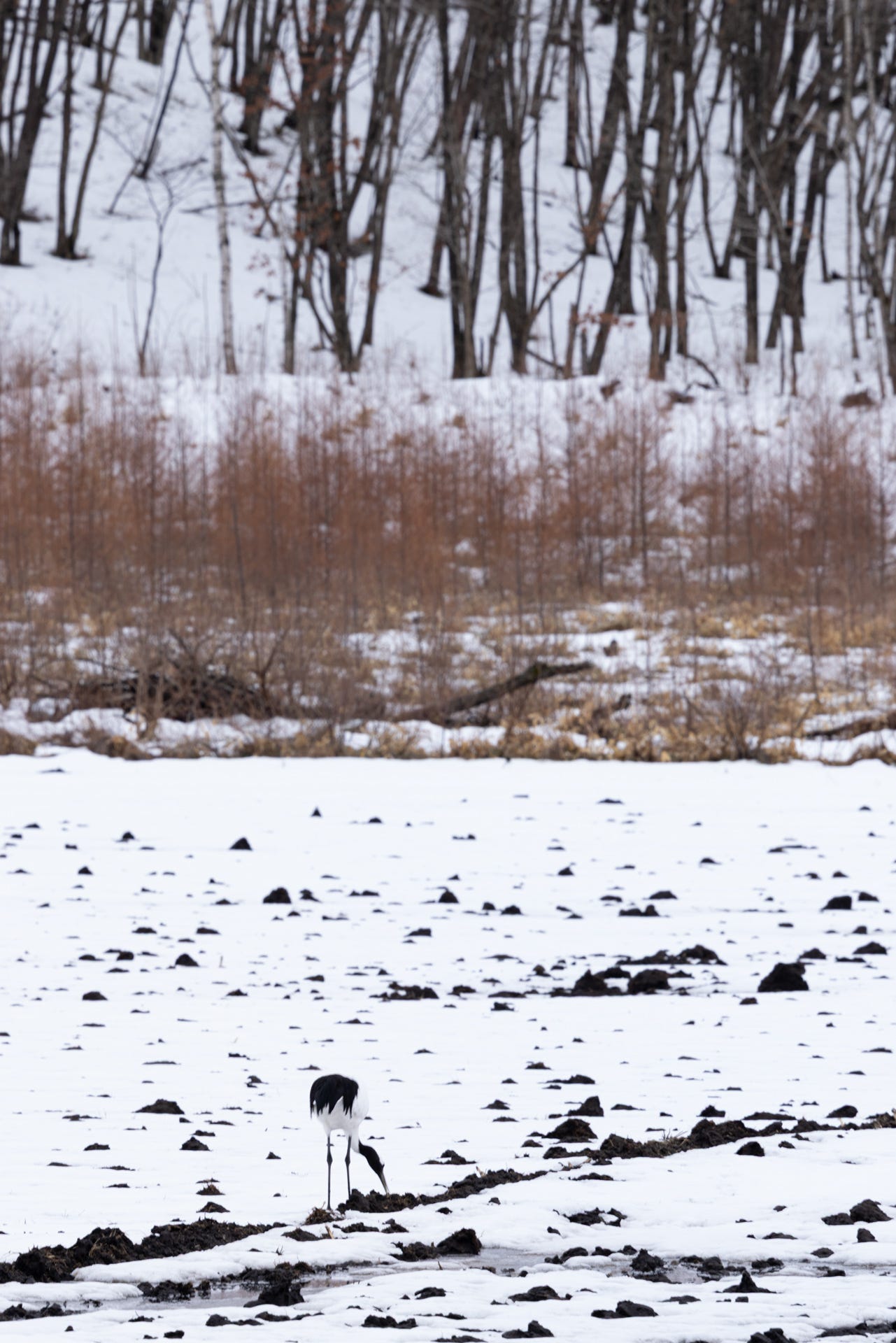
Telephoto compression was one of them. Long focal lengths visually compress distance, making separate parts of the landscape appear stacked closer together. Instead of feeling deep and continuous, the world begins separating into flatter layers.
There was also an element of Gestalt perception at play. Human vision naturally groups similar tones, textures, and patterns together. Snowfields, reed belts, forests, and mist each become their own visual regions, which is why a single photograph can sometimes feel like multiple images stacked together.
And finally, there is visual rhythm — the repetition of trunks, rocks, reeds, and negative space across the frame. Winter simplifies the landscape enough for these repeating forms to become more noticeable, almost musical in their spacing and flow.
Individually, these ideas are subtle. But together, they create the layered winter landscapes I unexpectedly found myself drawn toward in Hokkaido.
Searching for a Visual Parallel
Interestingly, none of this was intentional.
I did not travel to Hokkaido inspired by any particular art movement or visual tradition. The connection appeared only later, after returning from the trip and trying to understand why these images felt so visually separated and structured.
That curiosity eventually led me toward ukiyo-e.
While researching whether similar spatial phenomena had existed in historical art, I found myself repeatedly drawn to Japanese landscape prints — particularly the quieter atmospheric works of Utagawa Hiroshige.
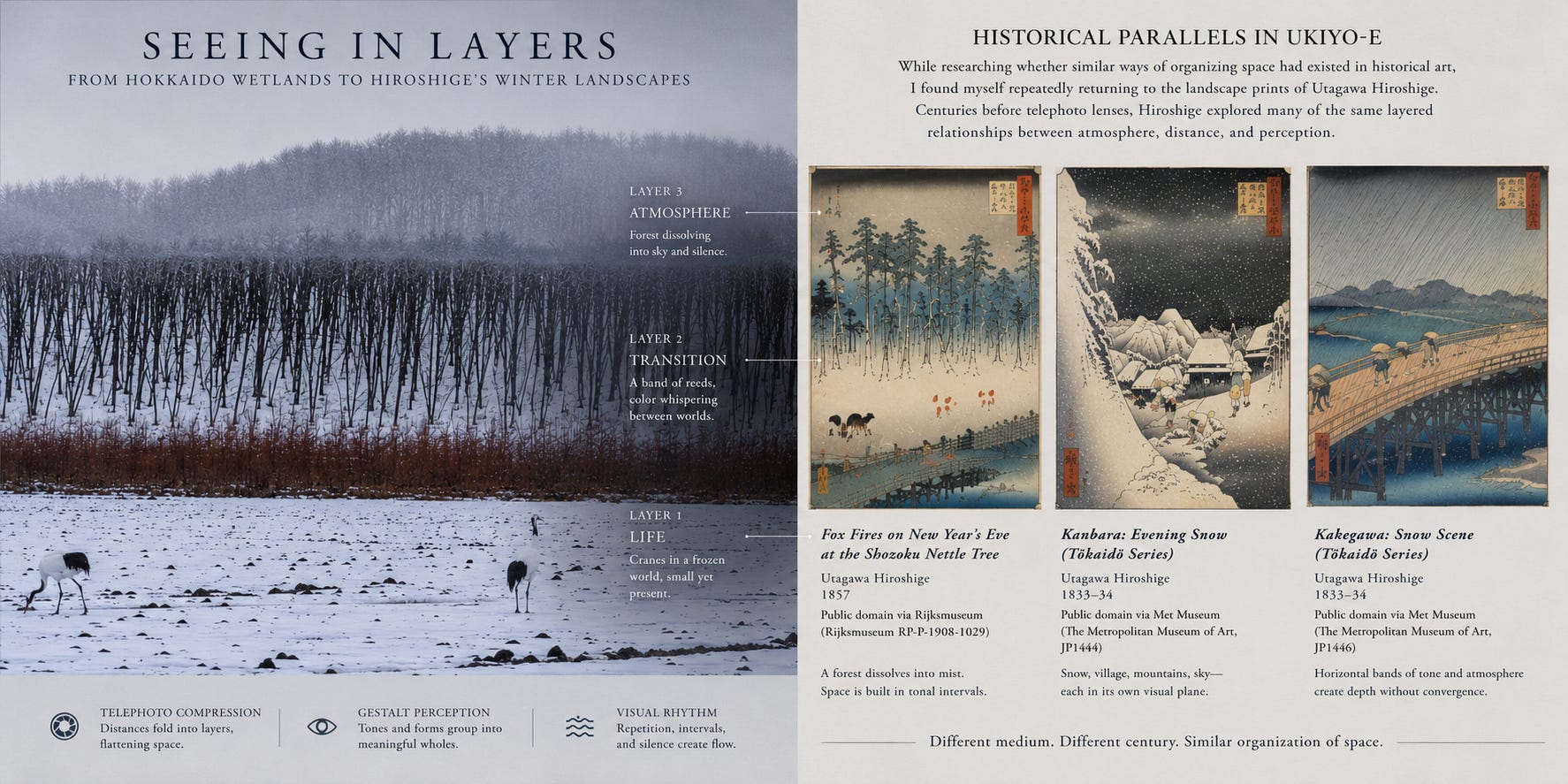
What resonated was not necessarily the subject matter, but the way space behaved within those images.
Many ukiyo-e landscapes organize the frame through layers and intervals rather than strong linear depth. Snow, water, mist, forests, and sky often exist as separate visual regions while still remaining part of a unified composition. The eye drifts across the scene rather than moving directly into it.
That sensation felt remarkably close to what I had been experiencing through the viewfinder in Hokkaido.
The similarity was especially striking in winter-oriented prints where forests compress into texture, snow becomes open negative space, and atmosphere quietly separates one plane from another.
What fascinated me was that photography and ukiyo-e arrive at this layered perception through entirely different means.
Ukiyo-e achieved it through artistic interpretation and compositional stylization.
The photographs achieve it through:
optical compression,
atmospheric flattening,
tonal simplification,
and perceptual grouping.
The overlap, therefore, is not imitation.
It is convergence.
Different mediums.
Different centuries.
Yet arriving at a strangely similar way of organizing space.
That realization changed how I began thinking about these images. I stopped seeing them purely as wildlife or winter photographs and started viewing them as studies in perception — moments where optics quietly transform reality into layered abstraction.
Winter as an Abstraction Engine
I suspect winter may be uniquely suited for this kind of visual experience.
Snow removes clutter.
Color palettes collapse into restraint.
Foreground distractions disappear.
Shadows soften beneath overcast skies.
The world simplifies itself into line, tone, rhythm, and silence.
Under those conditions, landscapes stop behaving purely as physical environments and begin functioning almost like visual structures.
The camera intensifies this transformation further.
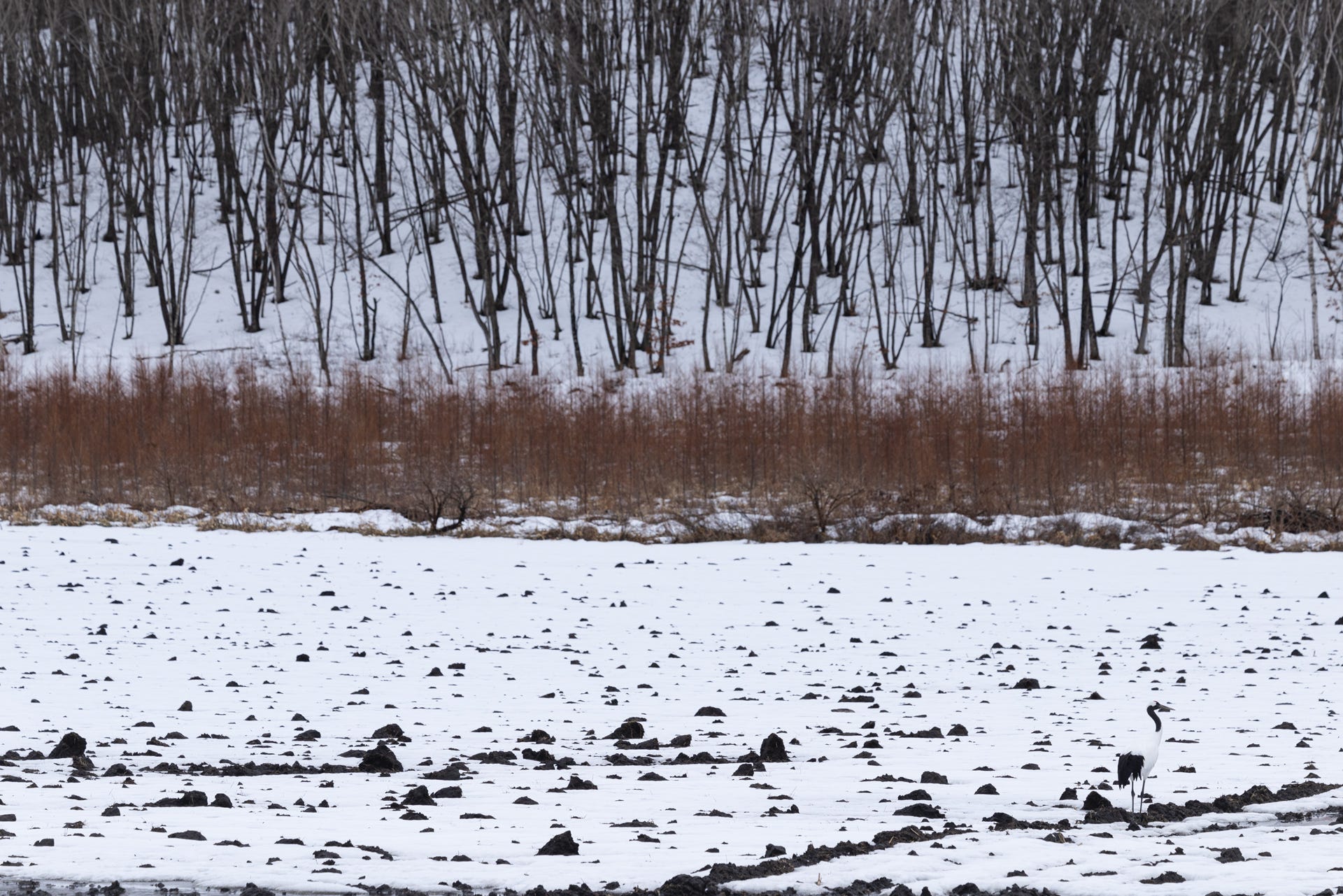
The moment the frame edges isolate the scene, the eye stops navigating physical space and instead begins reading intervals:
foreground,
transition,
structure,
atmosphere.
That was the most unexpected lesson Hokkaido offered me.
I arrived searching for vibrant winter and monochrome quietness.
I left discovering layered perception.
Looking Ahead
What began as a winter wildlife trip has quietly reshaped how I now look at landscapes.
I am increasingly interested in searching for places where this phenomenon might emerge again — environments where atmosphere, distance, weather, and optics work together to create layered spatial separation.
Not necessarily dramatic landscapes.
Not necessarily famous locations.
Just places where the world simplifies enough for its internal structure to reveal itself.
Hokkaido happened to offer those conditions naturally:
snow, mist, telephoto distance, muted tonality, and silence.
But I suspect this visual language exists elsewhere too, waiting quietly in landscapes that reward slower observation.
Perhaps that is what photography continues to teach me most:
sometimes the camera does not merely document a place.
Sometimes it changes the way we perceive space itself.
