
A few weeks ago, one of the photographs from this series, Vamana, was selected as a finalist in the Black & White category of the ReFocus Awards.
The image sparked an unexpected response. Friends who had seen it over the past several months kept asking the same questions:
“How was this created?”
“Was it made in-camera?”
“What were you trying to show?”
“Why does it feel mythological?”
I promised to write about it when I first shared the image shortly after returning from Antarctica in October 2025. Like many unfinished promises to myself, it remained buried beneath work, travel, writing and countless photographs waiting to be processed.
The ReFocus recognition felt like the right moment to finally tell the story.
Because these photographs were never planned as a project.
They emerged gradually during the journey.
And like many of my favourite images, they began with a problem.
The Problem of Scale
Antarctica, South Georgia and the Falkland Islands repeatedly confronted me with a challenge that a single photograph struggled to solve.
Scale.
A portrait could show an individual bird.
A landscape could show the colony.
But neither could convey what it felt like to stand there.
One of the earliest moments came on Steeple Jason Island in the Falklands.
Before landing, we had been briefed that we would be visiting one of the world’s largest Black-browed Albatross colonies.
I knew the numbers.
I had seen the photographs.
But numbers and photographs do not prepare you for the experience.
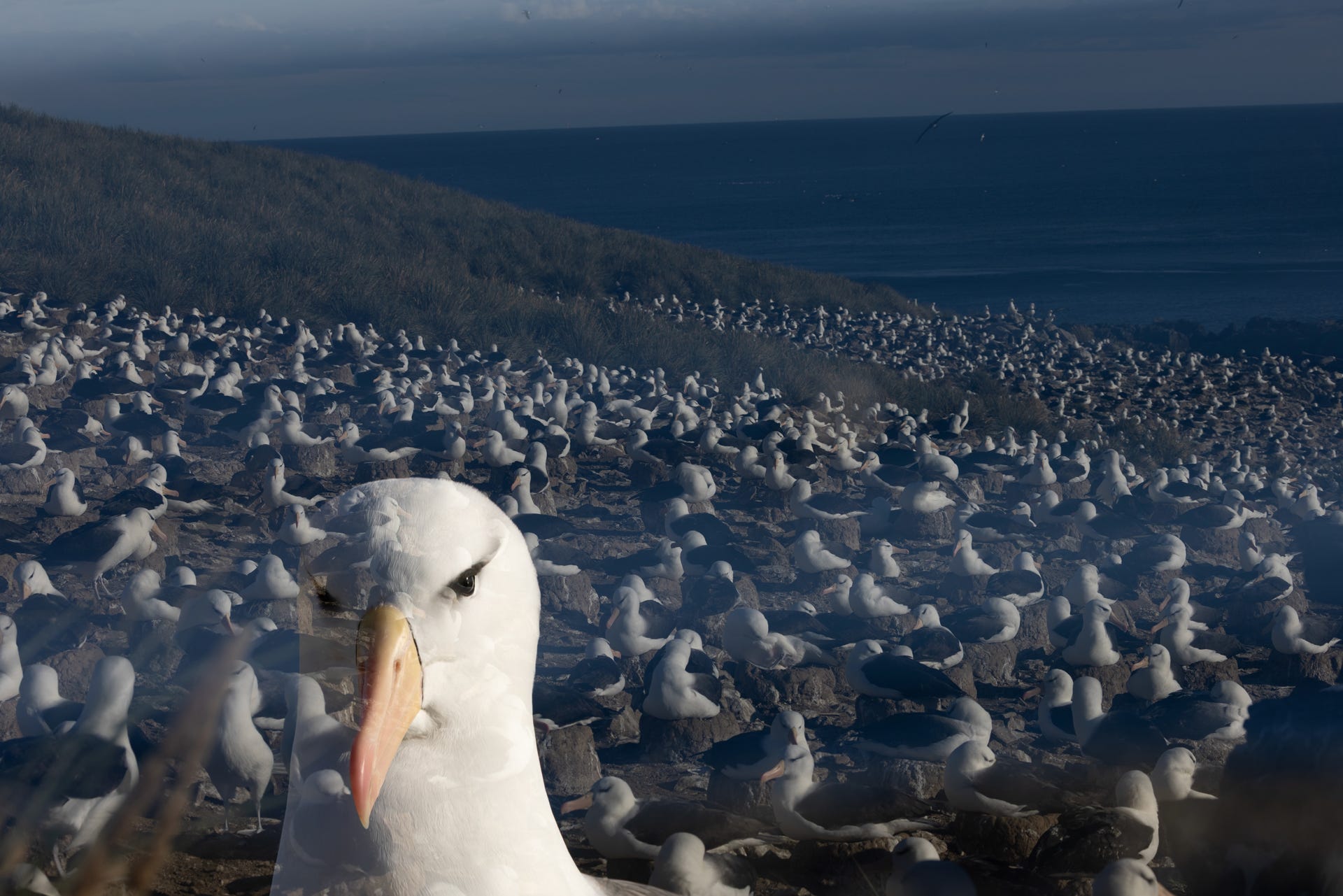
As I climbed the slope and looked across the colony, thousands upon thousands of albatrosses occupied the hillsides in every direction.
My instinct was to photograph an individual bird.
My second instinct was to photograph the colony.
Neither image felt complete.
The bird lacked context.
The landscape lacked intimacy.
I wanted both.
That was the moment the experiment began.
Discovering Multiple Exposure
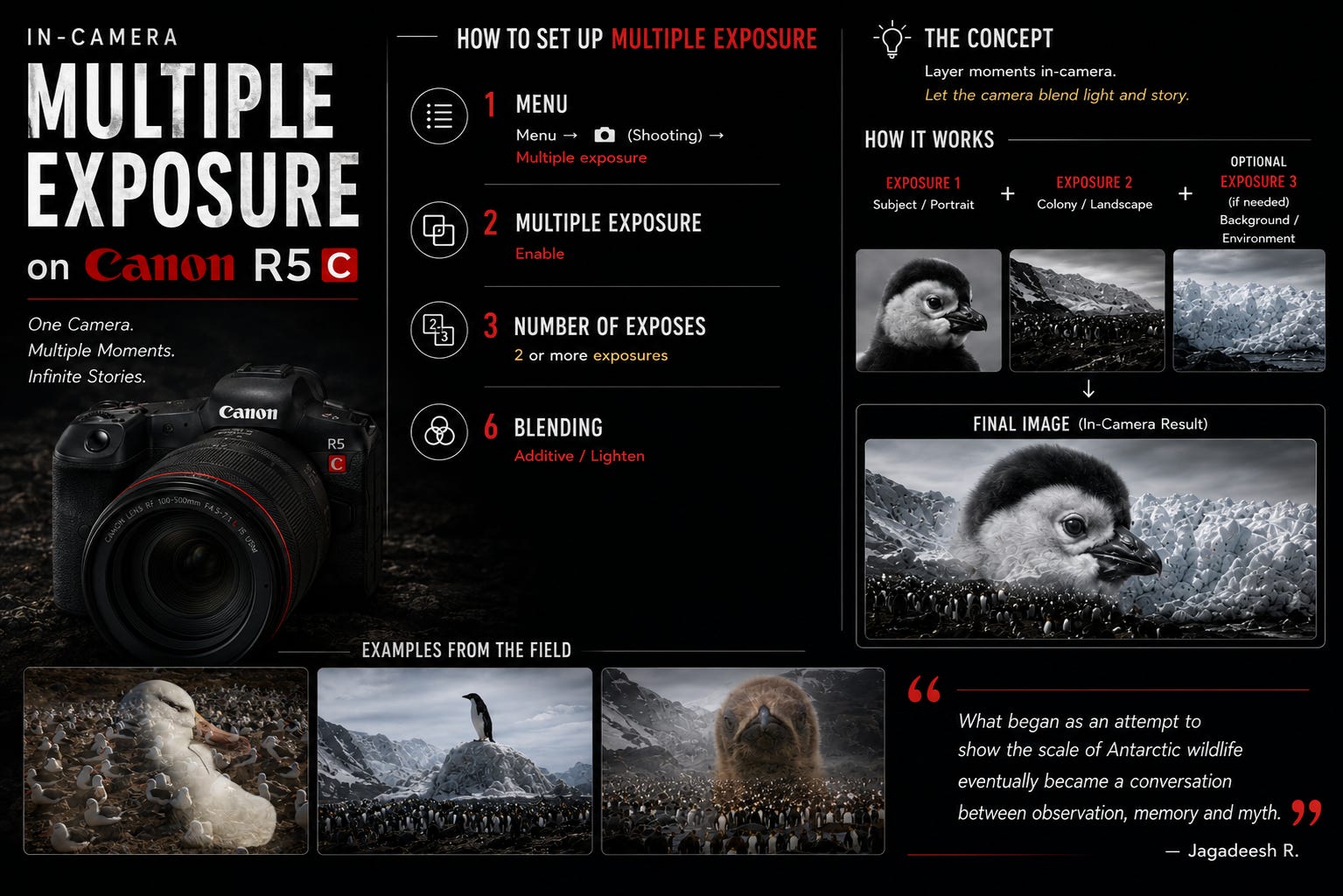
The Canon R5C includes an in-camera multiple exposure mode.
It is a feature that many photographers know exists but few use regularly.
I had experimented with it before, but mostly as a creative exercise.
This time it felt useful.
Instead of creating a portrait and a landscape separately, I wondered whether I could combine them into a single frame.
Not digitally.
Not later in Photoshop.
But in-camera.
The goal wasn’t artistic abstraction.
At least not initially.
The goal was documentation.
I wanted to document how the place felt.
My settings remained remarkably simple throughout the project:
Canon R5C
RF 100-500mm lens
Multiple Exposure mode
Continuous shooting
Additive/Luminance blending
Mostly 2 exposures per image (3 exposures only for Vamana)
Luminance blending proved especially important.
It allowed brighter areas from one frame to merge naturally with darker regions from another, creating layered images that retained structure without becoming visually chaotic.
The process quickly became addictive.
Instead of searching for a decisive moment, I began searching for relationships between moments.
Rajahamsa
The first successful image from the experiment became what I later titled Rajahamsa.
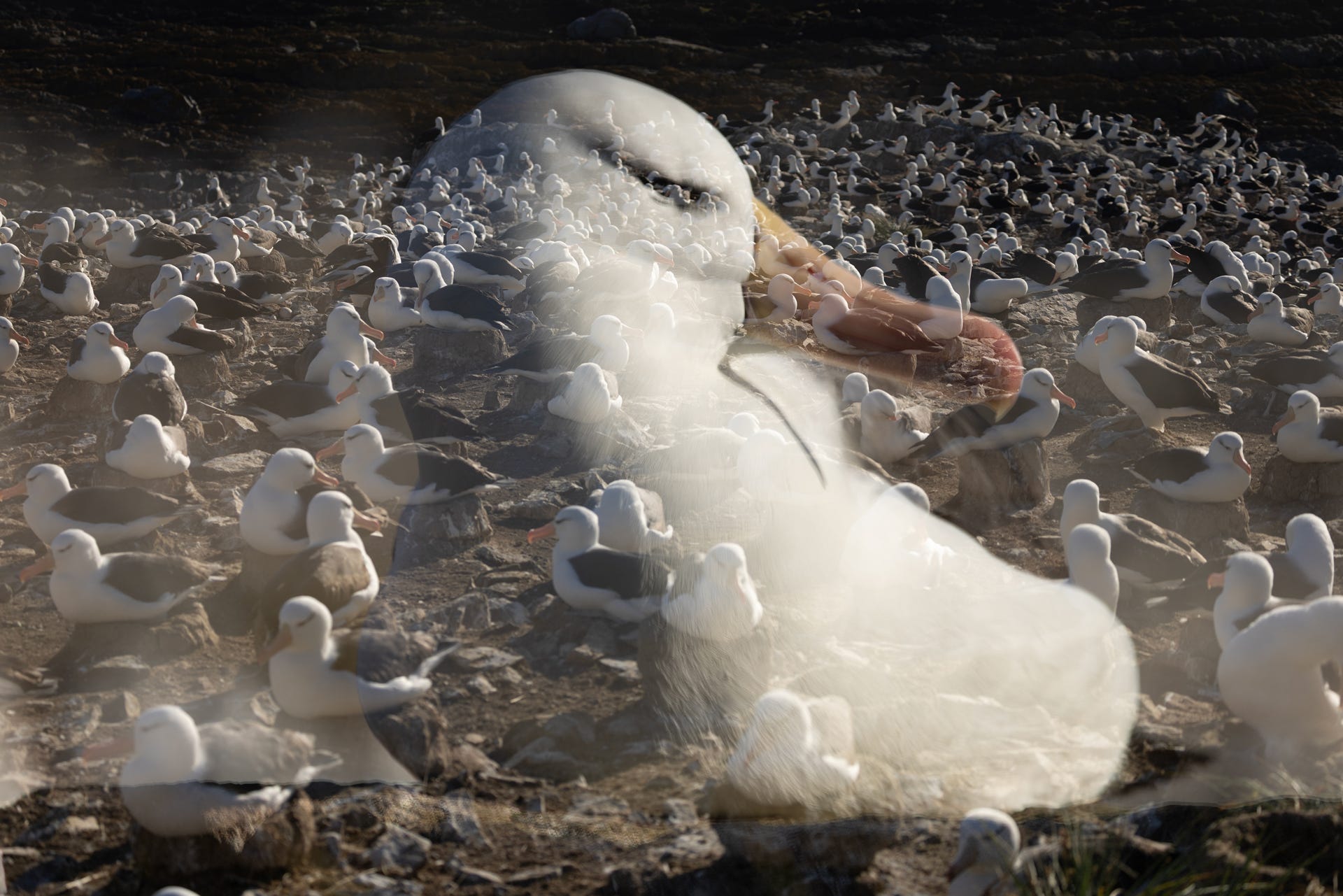
A Black-browed Albatross emerged from within its own colony.
The bird was simultaneously an individual and a multitude.
The more I looked at the image, the less it felt like a documentary photograph.
Something symbolic had appeared.
At the time I couldn’t fully explain it.
I only knew the image felt different.
It seemed to contain an idea rather than merely a subject.
Looking back now, I realize that was the first indication that the project was heading somewhere unexpected.
From Observation to Archetype
The transformation happened gradually.
Not during editing.
Not even during shooting.
It happened while looking.
Many of the stories we encounter in childhood never truly leave us.
They remain dormant somewhere beneath conscious thought.
Standing among vast colonies of birds and seals at the edge of the world, those stories began resurfacing.
Not literally.
Symbolically.
The animals remained animals.
But they also began to resemble archetypes.
The same way clouds occasionally resemble faces.
Or mountains resemble sleeping giants.
The photographs were becoming bridges between observation and imagination.
Vamana
The turning point arrived with a lone penguin(Aďelé) standing alone an ice scape and there near by an immense colony of Adele and Rockhopper (I recall!)
Unlike the other images in the series, Vamana required three exposures.
An individual penguin.
The colony below.
The surrounding landscape.
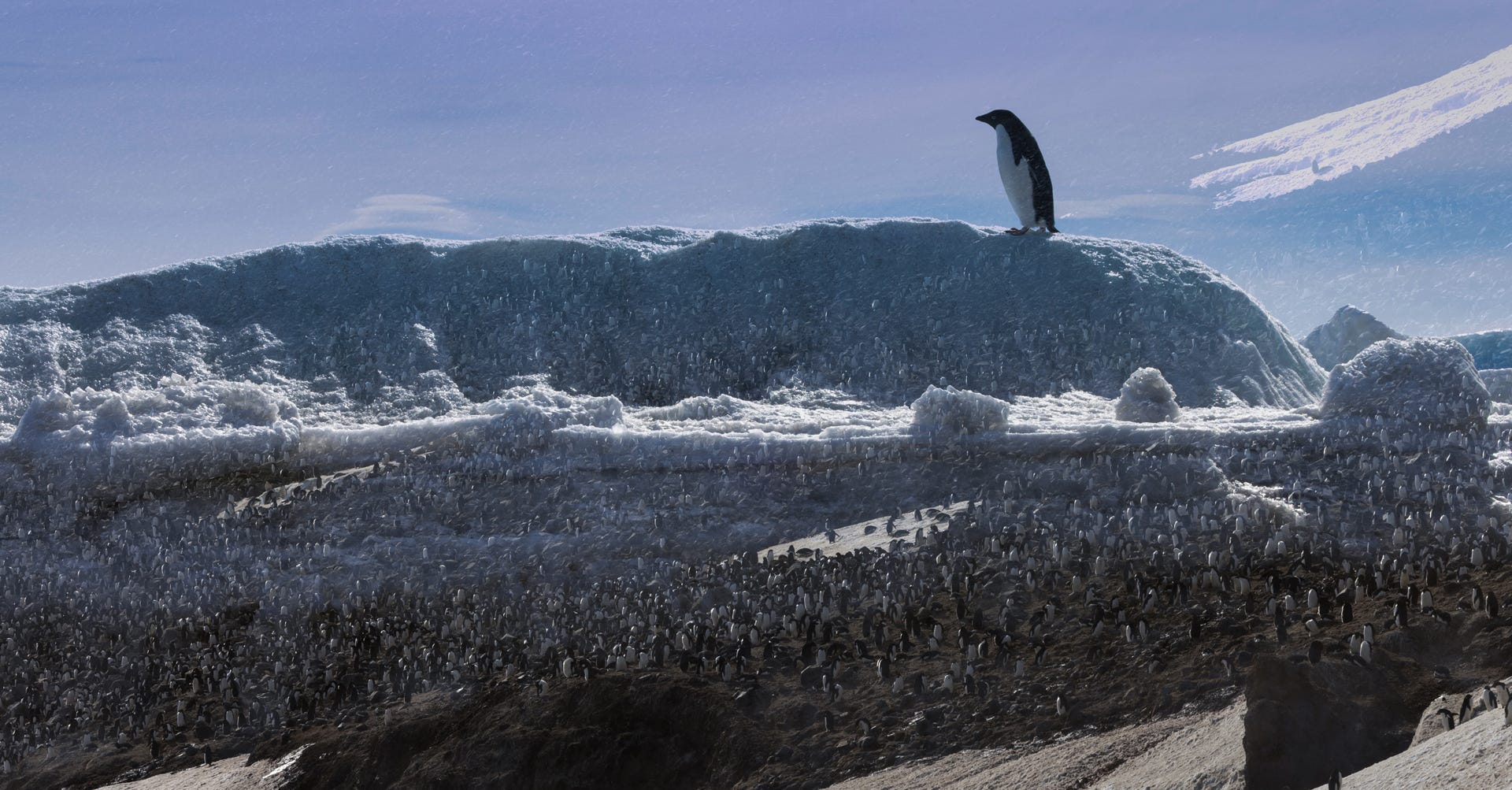
When the image appeared on the camera screen, something immediately felt familiar.
A small figure.
An immeasurable world.
A paradox of scale.
It reminded me of Vamana, the dwarf incarnation who expands beyond expectation and measures the universe itself.
The connection was not deliberate.
It emerged after the photograph existed.
The mythology wasn’t guiding the image.
The image was awakening the mythology.
For the first time I began wondering whether these photographs might belong together as a series.
Jatayu
If there is a photograph that convinced me the project was real, it was Jatayu.
Captured among the king penguin colonies of South Georgia, the image combines a chick’s portrait with thousands of penguins spread across a glacial valley.
The resulting figure feels monumental.
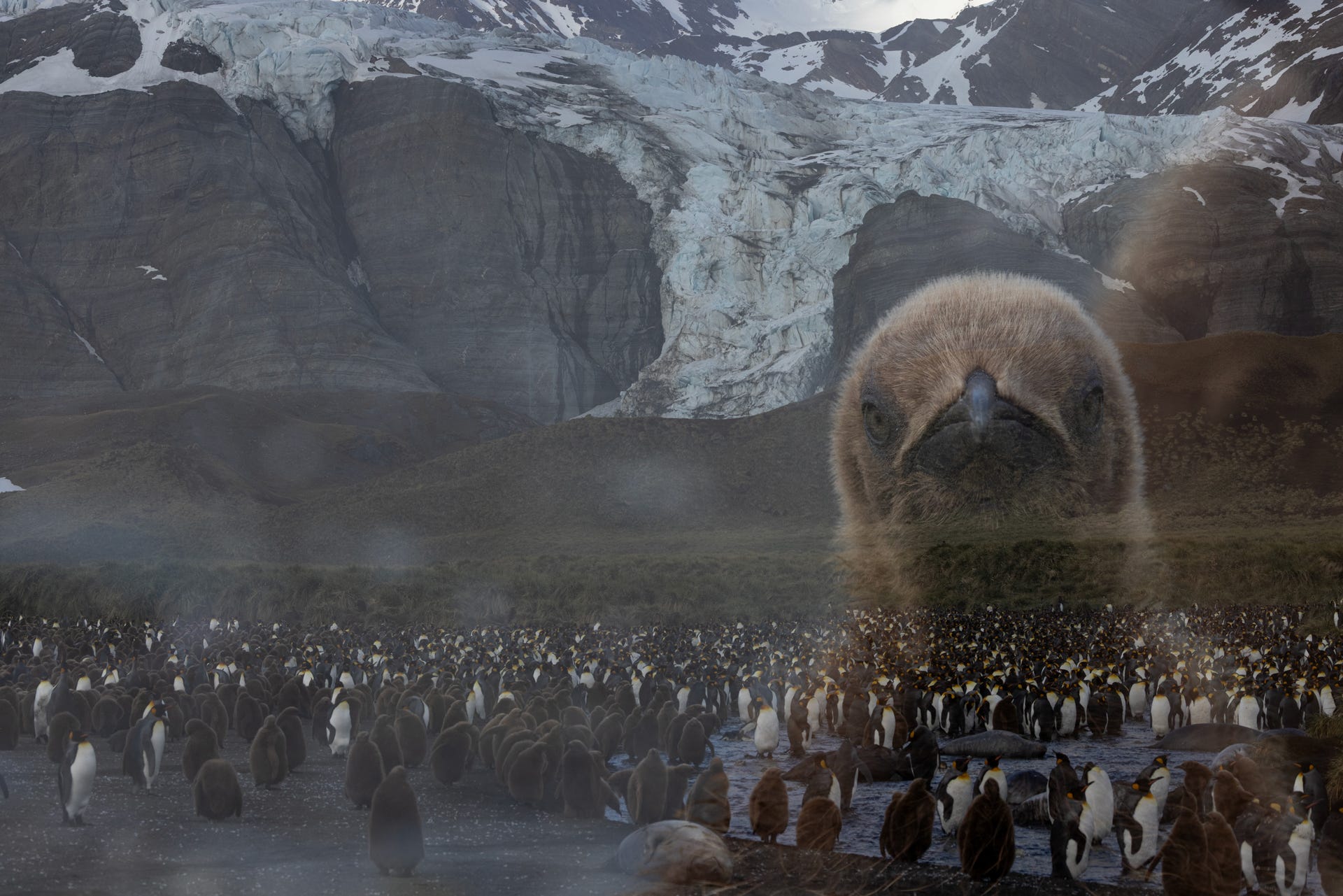
Protective.
Almost watchful.
The glacier behind it only amplifies that sensation.
I remember staring at the rear LCD and immediately thinking:
“That looks like Jatayu.”
Not because it resembled any traditional depiction.
But because it carried the emotional weight I associated with the character.
Courage.
Guardianship.
Sacrifice.
For the first time, I stopped thinking about multiple exposure as a technique.
And started thinking about it as a language.
When Wildlife Becomes Myth
One question I am often asked is whether these photographs were intended to illustrate Hindu mythology.
The answer is no.
At least not consciously.
I wasn’t searching for Vamana.
I wasn’t searching for Jatayu.
I wasn’t searching for Rajahamsa.
I was searching for ways to describe experiences that exceeded the limits of a single frame.
The mythology appeared later.
What fascinates me now is that this happened almost automatically.
Faced with extraordinary wildlife spectacles, my mind reached for archetypes I had inherited through stories.
Perhaps that is what myths have always done.
They give us a language for experiences that feel larger than ordinary reality.
Technical Notes
All photographs in this series were created entirely in-camera using the Canon R5C.
No compositing was performed in post-processing.
The images rely on:
Multiple Exposure mode
Continuous shooting
Luminance blending
Telephoto compression using the RF 100-500mm lens
Most images use two exposures.
Vamana uses three exposures.
What appears complex is actually the result of repeated experimentation in the field and a willingness to embrace unpredictability.
The final image often revealed itself only after the shutter sequence was complete.
Looking Back
When I boarded the expedition vessel, I expected wildlife photography.
I did not expect a conversation with memory.
Yet that is ultimately what this project became.
The Southern Ocean presented extraordinary animals, extraordinary landscapes and extraordinary scale.
Multiple exposure allowed those experiences to coexist within a single frame.
And somewhere between observation and imagination, the birds became archetypes.
Not because they ceased being wildlife.
But because they became something more.
A reminder that every act of seeing is shaped by the stories we carry with us.
more images from the series arrived unexpectedly,
Matsya → Preservation of life
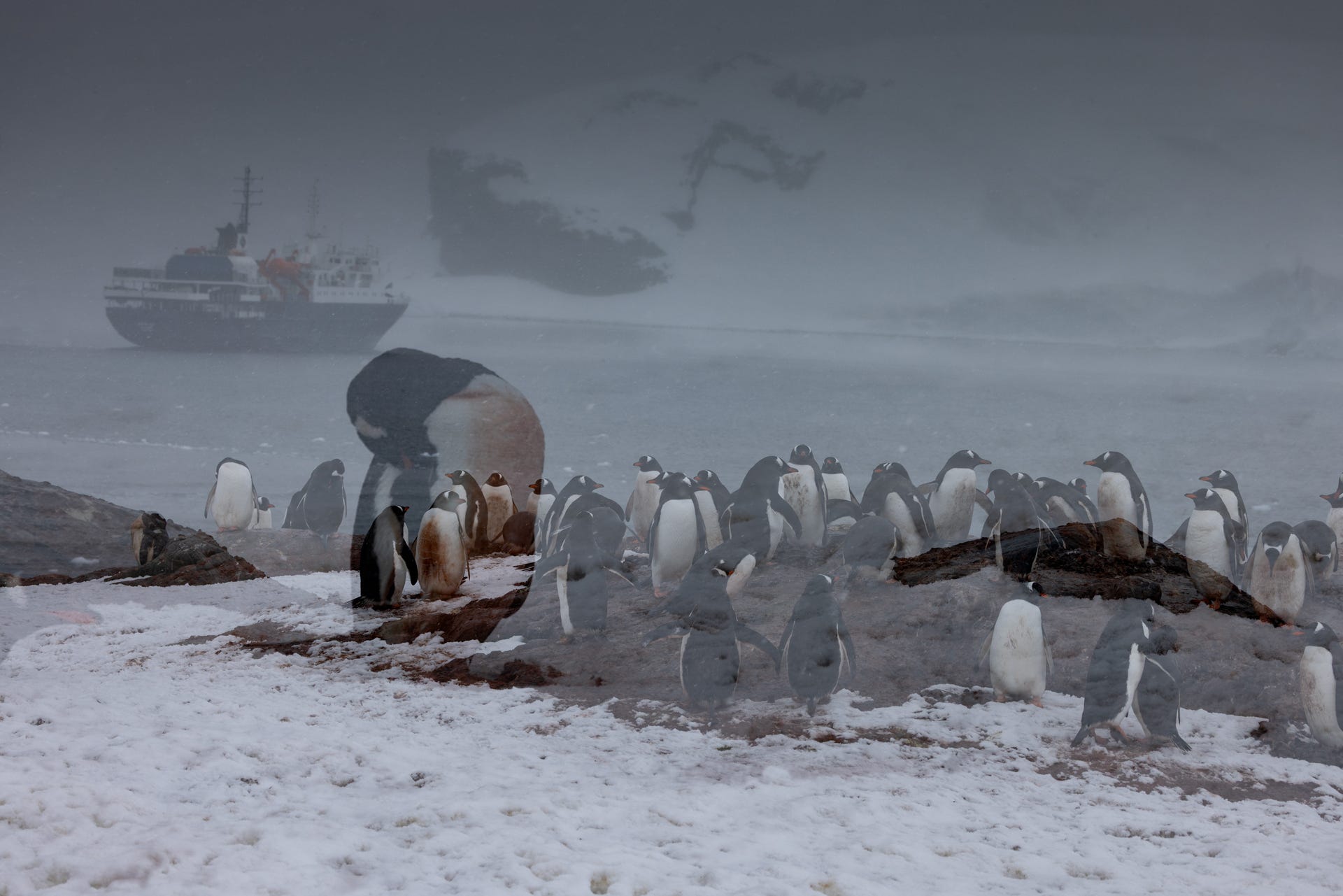
While photographing a Gentoo penguin colony in Antarctica, I created a multiple exposure that combined the landscape, the colony, and a solitary penguin. Later, as I revisited the frame, it reminded me of Matsya, the fish incarnation of Vishnu in Hindu mythology.
In the ancient story, Matsya appears during a great deluge and guides a vessel carrying life through the flood, ensuring continuity when the world stands on the edge of destruction. In this photograph, the expedition ship (our own Ortelius MV) rests in the distant background while the penguin emerges as a quiet, symbolic guide in the foreground. The resemblance was not planned in the field, but revealed itself later—one of those moments where photography becomes less about recording what is seen and more about discovering meaning within what was witnessed.
Whether coincidence or subconscious association, the image felt like a reminder that stories often exist before we recognize them. The camera records light; imagination completes the journey.
Varaha → Restoration of the world
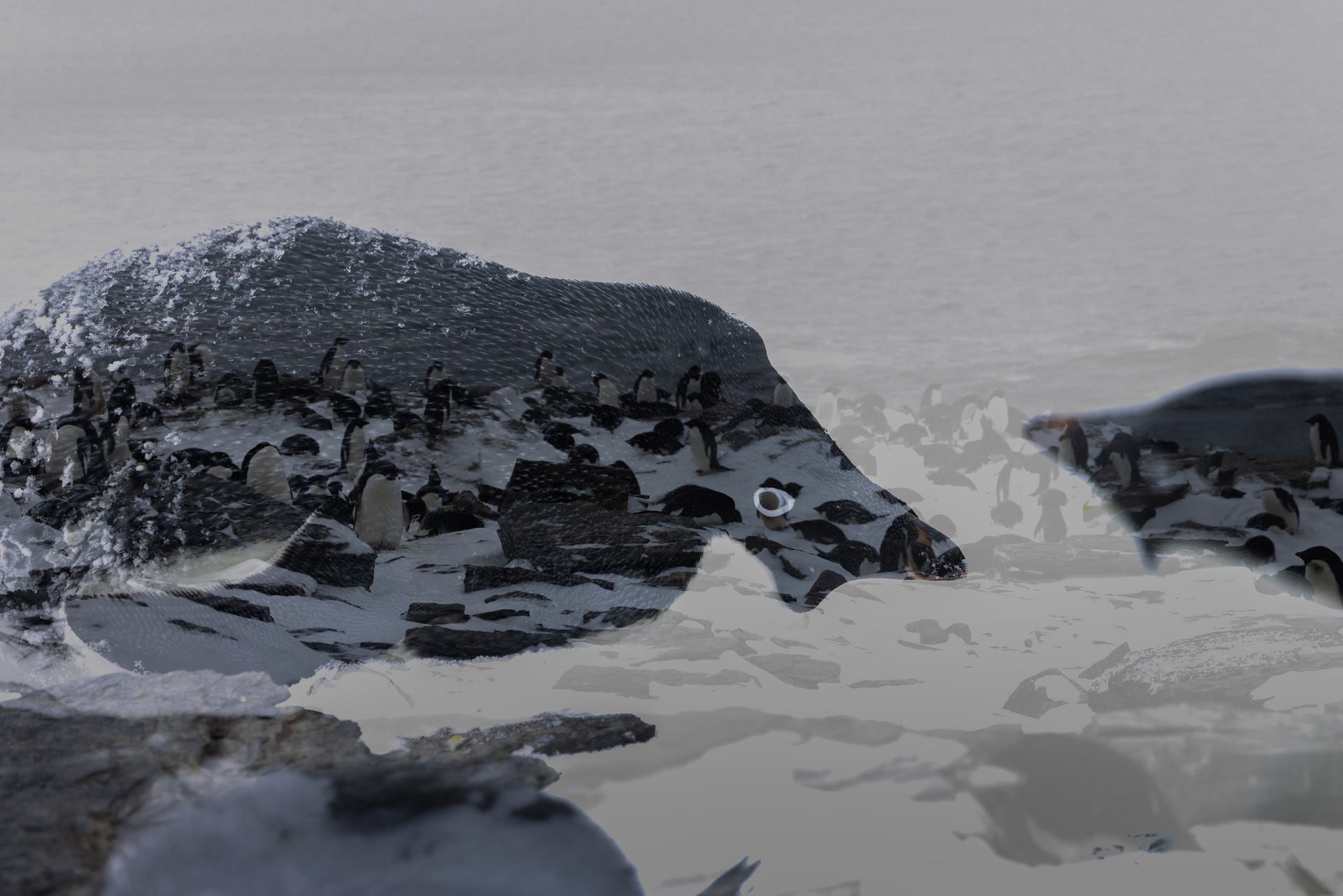
By the end of the expedition, I had stopped looking for specific characters. Instead, I simply observed and waited for forms to emerge on their own. Varaha appeared unexpectedly—in the shape of ice, snow, and a colony scattered across the shoreline. In Hindu mythology, Varaha rescues the Earth from cosmic waters and restores balance to the world. Standing in Antarctica, a place that constantly reminds us of both fragility and endurance, I found the symbolism difficult to ignore. It became a fitting final archetype: not a story of survival alone, but of renewal.
I will be Continuing the search for new archetypes in new landscapes in the future
What began as an experiment has quietly become an ongoing creative pursuit. I now find myself actively searching for new characters and visual metaphors wherever I travel. They may emerge from different landscapes, different species, and different cultures, but the underlying idea remains the same: finding stories that exist somewhere between reality and imagination. More than anything, this project reminded me how much joy there is in playful exploration. I had an incredible amount of fun creating these images, and I look forward to discovering where the next character appears. You can follow my work here
